Guelph, ON, March, 9, 2022- The next exciting step in regenerative therapies has Dr. Thomas Koch, Ontario
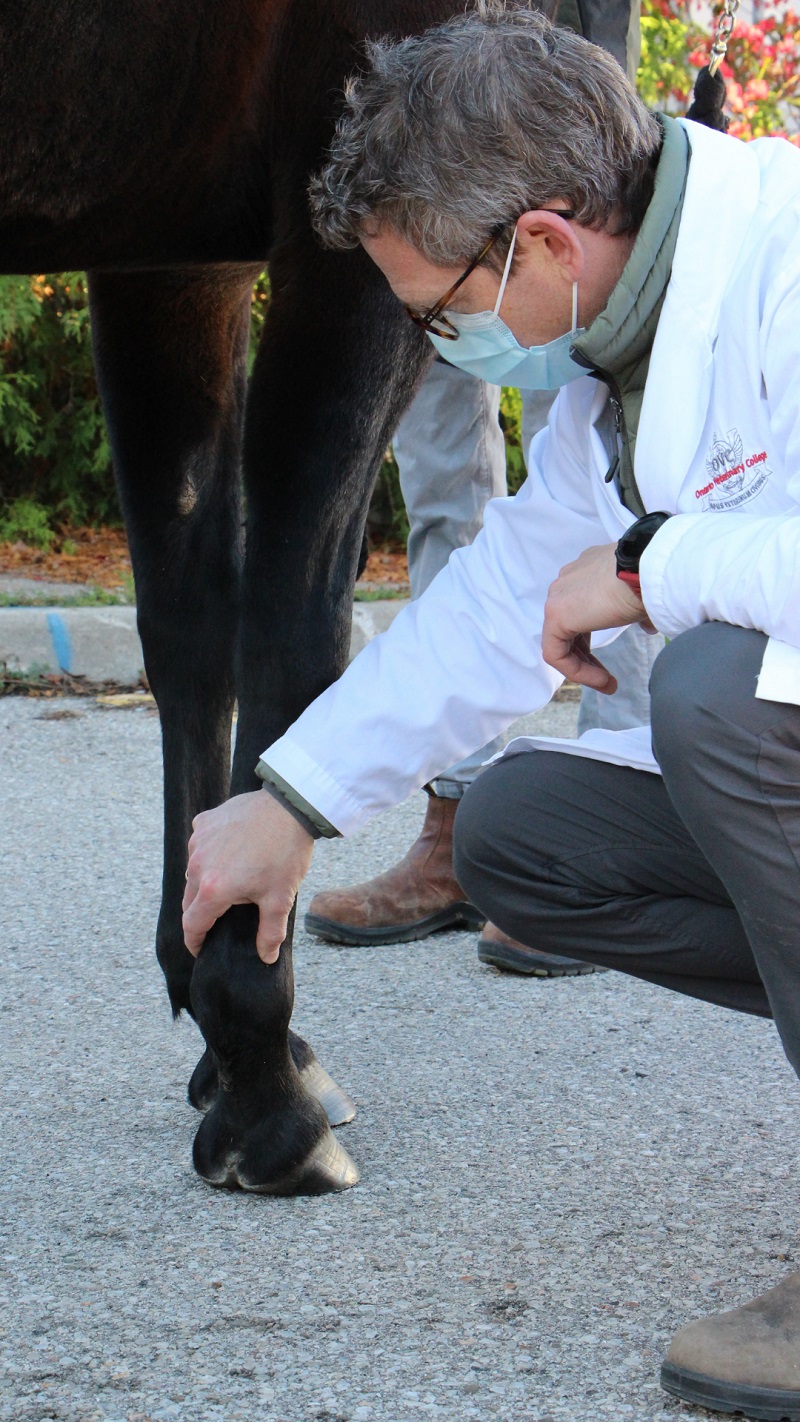
Dr. Koch examines a horse’s fetlock (Equine Guelph photo)
Veterinary College, and his team encapsulating stem cells to see if they can enhance the effect of treatment. Horses with osteoarthritis in their joints stand to benefit from a therapy with a slower release time.
“When you encapsulate the cells within hydrogel, you can keep the cells in the joint longer, and this may lead to better treatment outcomes,” explains Koch.
In this safety study, the researchers will be comparing the effect of injecting cells alone versus encapsulated cells. Mesenchymal Stromal Cells (MSC) have been shown to alleviate pain in mild to moderate osteoarthritis of the fetlock joint. To date, these cells have been from single donor animals. In human medicine, there is work suggesting that combining cells from multiple donors produces a better product with more predictable functionality.
Equine researchers are comparing stem cells collected from just one donor to cells obtained from many.
“In order to have a more standardized product, there may be advantages to pooling cells from multiple donors,” says Koch, who added that a student in his lab, Olivia Lee, recently published a paper on this topic. In the past year, Koch and his commercial partner, Likarda, LLC (Kansas City) have been optimizing a method for freezing down the encapsulated cells.
“Having a frozen product will be much more useful to veterinarians,” says Koch.
Stored right at the clinics they would be readily available for use after thawing. Freezing encapsulated cells has been a new and challenging venture with the goal of having a treatment ready to inject as soon as it is needed.
The next step in the project is to inject cells into joints in vivo and then monitor if there are any significant reactions comparing saline to unencapsulated and encapsulated cells.
“This research has been more than 10 years in the works, and we are very grateful for the support from Equine Guelph and its partners to allow us to pursue these studies,” says Koch. “We are getting to the point where we will be working with live horses; getting closer and closer to clinical application of these technologies, which is very exciting.”

 USA
USA Canada
 Australia
 New Zealand
 Europe
 UK / IRE